
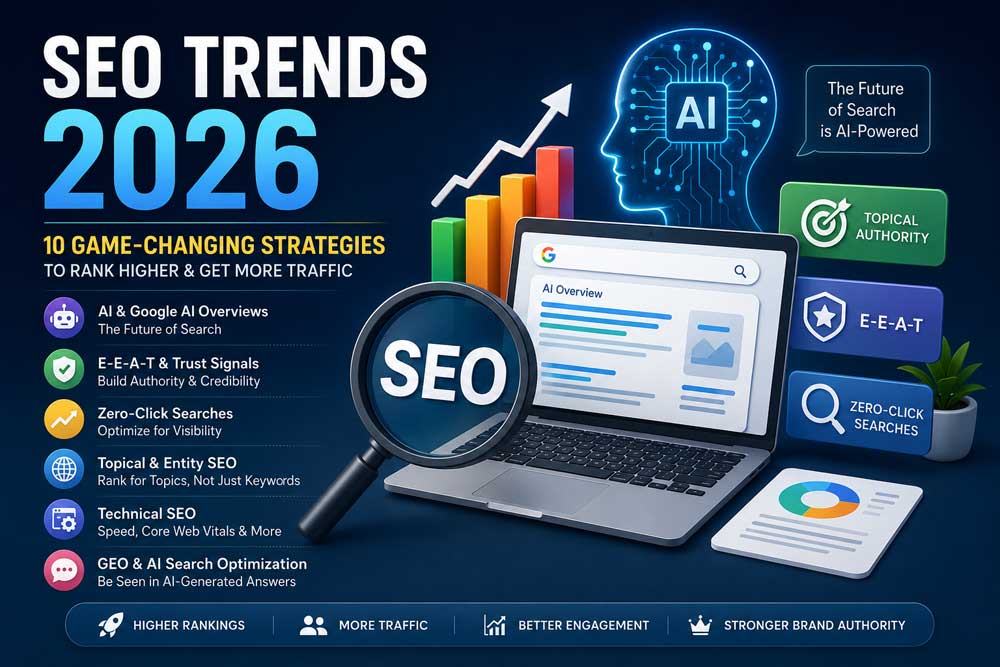
Search engine optimization is evolving faster than ever. The traditional SEO playbook focused on keywords, backlinks, and technical optimization. While those factors still matter, the rise of AI-powered search experiences, Google AI Overviews, conversational search, and zero-click results is reshaping how websites earn visibility.
If you’re still relying on SEO strategies from a few years ago, you’re already falling behind.
In this guide, we’ll explore the most important SEO trends for 2026 and explain how businesses, marketers, and website owners can adapt to stay competitive in an AI-first search landscape.
1. AI Search Optimization Is Becoming Essential
Google’s AI Overviews and AI-powered search experiences are changing how users consume information. Instead of clicking multiple websites, users increasingly receive summarized answers directly within search results. Google has also published guidance on how website owners can optimize for AI-powered search experiences.
This means your content must be:
- Clearly structured
- Factually accurate
- Expert-driven
- Easy for AI systems to understand
The goal is no longer just ranking #1. The goal is becoming a trusted source that AI systems cite in their responses.
Action Steps
- Create detailed topic clusters
- Use schema markup
- Include expert insights and original data
- Answer questions directly
2. E-E-A-T Continues to Dominate Rankings
Google’s focus on Experience, Expertise, Authoritativeness, and Trustworthiness (E-E-A-T) remains stronger than ever.
Websites that demonstrate real-world experience and expertise consistently outperform thin, AI-generated content.
To strengthen E-E-A-T:
- Showcase author credentials
- Add case studies
- Publish original research
- Display testimonials and reviews
- Maintain transparent business information
In competitive industries such as finance, healthcare, legal services, and digital marketing, E-E-A-T is no longer optional.
3. Zero-Click Searches Are Reshaping SEO
A growing percentage of searches end without users clicking on a website. AI Overviews, featured snippets, knowledge panels, and direct answers are responsible for this shift. Industry studies continue to show declining click-through behavior as AI-generated answers become more common.
This doesn’t mean SEO is dead.
It means SEO success must be measured differently.
New SEO Metrics
- Brand visibility
- AI citations
- SERP real estate
- Branded searches
- Conversions rather than clicks
Businesses that build strong brands will benefit the most from this transition.
4. Topical Authority Beats Keyword Stuffing
Search engines now understand topics better than individual keywords.
Instead of publishing dozens of thin articles targeting similar phrases, successful websites are creating comprehensive content hubs.
For example, a digital marketing website should create:
- SEO guides
- Technical SEO tutorials
- Local SEO content
- Link building resources
- AI SEO articles
Together, these assets build topical authority and improve rankings across hundreds of related searches.
5. Entity-Based SEO Is Growing Rapidly
Google increasingly relies on entities rather than keywords to understand content.
An entity can be:
- A person
- A business
- A product
- A location
- A concept
Instead of focusing only on keyword density, modern SEO requires building clear relationships between entities.
How to Improve Entity SEO
- Use structured data
- Build strong author profiles
- Create detailed About pages
- Earn mentions across trusted websites
- Maintain consistent business information
Entity optimization helps search engines better understand your brand and expertise.
6. Technical SEO Remains a Competitive Advantage
Many websites still struggle with basic technical SEO issues.
In 2026, technical optimization continues to separate high-performing websites from average competitors.
Key areas include:
Core Web Vitals
- Fast loading speed
- Stable layout
- Smooth user interaction
Crawlability
- Clean site architecture
- Optimized XML sitemaps
- Proper internal linking
Indexation
- Eliminate duplicate content
- Fix orphan pages
- Monitor Search Console regularly
Technical SEO provides the foundation that supports every other ranking factor.
7. AI-Generated Content Requires Human Enhancement
AI tools have made content production easier than ever.
However, publishing raw AI-generated content is becoming less effective.
The winning formula is:
AI + Human Expertise
Successful content teams are using AI to:
- Research topics
- Create outlines
- Generate drafts
Then adding:
- Real experience
- Expert commentary
- Unique insights
- Original examples
This combination creates content that both users and search engines trust.
8. Search Intent Is More Important Than Keywords
Google’s algorithms continue to prioritize user intent over exact-match keywords.
Before creating content, ask:
- Is the user seeking information?
- Comparing options?
- Looking to purchase?
- Searching for local services?
The better your content satisfies search intent, the higher it is likely to perform.
This trend aligns with Google’s continued emphasis on user-focused SEO practices.
9. Brand Signals Are Becoming Stronger Ranking Factors
As AI search evolves, brand recognition becomes increasingly valuable.
Strong brands tend to:
- Earn more mentions
- Generate more branded searches
- Receive higher engagement
- Build greater trust
SEO professionals should collaborate with:
- Social media teams
- PR teams
- Content marketing teams
The future belongs to businesses that build brand authority across multiple platforms.
10. Generative Engine Optimization (GEO) Is the Next Evolution of SEO
Many marketers are discussing concepts such as Answer Engine Optimization (AEO) and Generative Engine Optimization (GEO).
Google’s own guidance suggests that success in AI search still depends largely on strong SEO fundamentals, but content must also be optimized for AI-generated experiences.
GEO Best Practices
- Answer questions clearly
- Use structured content
- Add FAQ sections
- Include statistics and citations
- Build authority around topics
Websites that become reliable information sources are more likely to appear in AI-generated answers.
The Future of SEO in 2026
SEO is not disappearing.
It is evolving.
The future belongs to websites that combine:
- Strong technical SEO
- Topical authority
- Entity optimization
- E-E-A-T principles
- AI search visibility
- Brand building
The biggest shift isn’t from SEO to AI.
It’s from ranking pages to becoming trusted sources of information.
Businesses that embrace this change today will dominate search visibility tomorrow.
Final Thoughts
SEO in 2026 is about much more than keywords and backlinks. AI-powered search experiences, zero-click results, topical authority, and trust signals are transforming how websites earn traffic and visibility.
If you focus on helping users, demonstrating expertise, and creating genuinely valuable content, you’ll be well-positioned for success regardless of how search technology evolves.
The future of SEO belongs to brands that build authority, trust, and relevance across the entire digital ecosystem.