
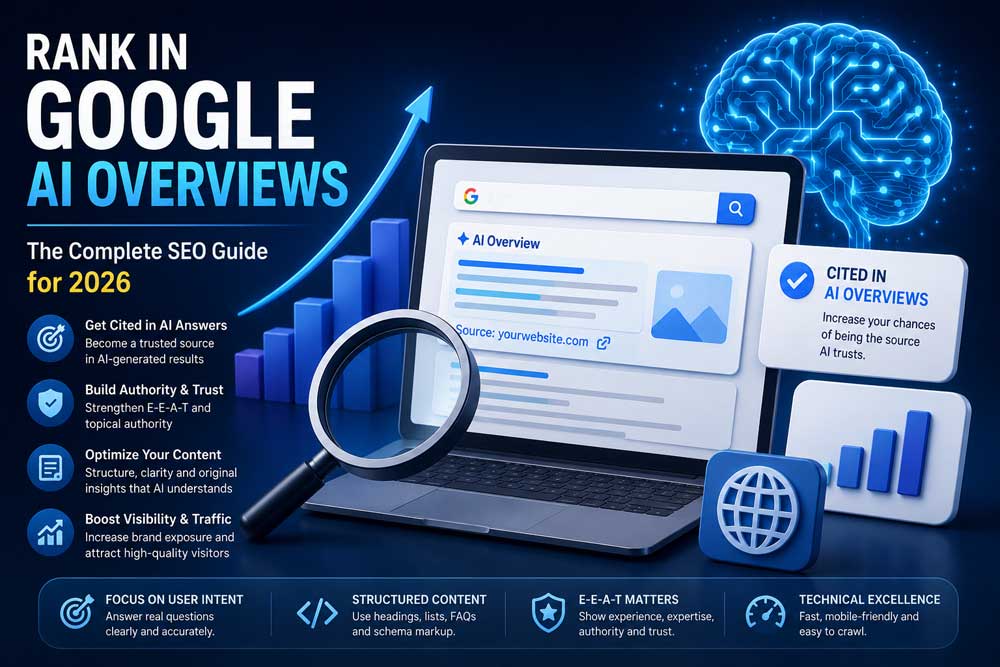
Google Search is undergoing its biggest transformation since its launch. Traditional blue links are increasingly being replaced or supplemented by AI-generated answers known as Google AI Overviews.
Many website owners are noticing a significant shift in their search traffic. While some pages are losing clicks, others are gaining visibility by becoming sources for AI-generated answers.
This has created a new challenge for SEO professionals: how do you optimize your content to appear in Google AI Overviews?
In this guide, you’ll learn exactly how AI Overviews work, why they matter, and the strategies that can help your content earn visibility in AI-powered search results.
What Are Google AI Overviews?
Google AI Overviews are AI-generated summaries that appear at the top of search results for many informational queries.
Instead of showing only traditional search listings, Google uses artificial intelligence to generate an answer by analyzing information from multiple trusted sources.
Users can often get answers without clicking through to individual websites.
For businesses and publishers, this means visibility is no longer limited to ranking in the first position. Your content can now be cited directly within AI-generated responses.
Why AI Overviews Matter for SEO
Google processes billions of searches every day. As AI Overviews become more common, they are changing user behavior.
Benefits of appearing in AI Overviews include:
- Increased brand visibility
- Enhanced authority and trust
- More qualified traffic
- Greater exposure for informational content
- Improved topical relevance
Websites that adapt early can gain a significant competitive advantage.
How Google Chooses Sources for AI Overviews
Although Google has not revealed every ranking factor behind AI Overviews, several patterns have emerged.
Pages frequently cited tend to have:
- Strong topical authority
- High-quality content
- Clear structure
- Demonstrated expertise
- Reliable factual information
- Positive user experience
Google wants AI-generated answers to be accurate and trustworthy.
This means content quality matters more than ever.
Build Topical Authority First
One of the strongest signals for AI visibility is topical authority.
Instead of creating isolated articles, build content clusters around a subject.
For example, if your website focuses on SEO, create content covering:
- Technical SEO
- On-Page SEO
- Link Building
- Local SEO
- SEO Tools
- AI SEO
- Google Algorithm Updates
When Google sees comprehensive coverage of a topic, your site becomes a trusted resource.
Create Content That Directly Answers Questions
AI systems love concise answers.
Every article should include direct responses to common user questions.
Good example:
How do I rank in Google AI Overviews?
To rank in Google AI Overviews, create expert-driven content, establish topical authority, use structured headings, answer questions clearly, and demonstrate strong E-E-A-T signals.
This format makes it easier for AI systems to extract and cite information.
Optimize for E-E-A-T
Google’s E-E-A-T framework remains essential.
E-E-A-T stands for:
- Experience
- Expertise
- Authoritativeness
- Trustworthiness
To improve these signals:
Show Real Experience
Share case studies and practical examples.
Display Author Information
Include detailed author bios and credentials.
Build Authority
Earn mentions and backlinks from reputable websites.
Increase Trust
Maintain accurate business information, privacy policies, and transparent contact details.
Use Structured Content
AI models prefer well-organized content.
Follow these formatting practices:
- Use descriptive H2 and H3 headings
- Keep paragraphs short
- Add bullet points where helpful
- Include FAQs
- Use tables when appropriate
Structured content improves readability for both users and search engines.
Add Original Insights
Generic content rarely stands out.
Instead, include:
- Industry observations
- Personal experiences
- Original research
- Survey data
- Case studies
- Expert opinions
Unique insights increase the likelihood of being cited by AI systems.
Strengthen Internal Linking
Internal links help Google understand relationships between topics.
Link related content naturally throughout your website.
For example:
An article about AI SEO can link to:
- Technical SEO guides
- Keyword research tutorials
- Content optimization articles
- Google algorithm update resources
Strong internal linking supports topical authority.
Focus on User Intent
Google AI Overviews are designed to satisfy user intent quickly.
Before writing content, identify whether the user wants:
- Information
- Comparison
- Guidance
- Solutions
- Local services
- Product recommendations
Content that fully satisfies intent is more likely to be featured.
Technical SEO Still Matters
Even the best content struggles if Google cannot crawl or understand it properly.
Important technical factors include:
- Fast page speed
- Mobile-friendly design
- Core Web Vitals optimization
- XML sitemap
- Proper indexing
- Structured data markup
Technical SEO provides the foundation for AI visibility.
Common Mistakes to Avoid
Many website owners are making errors that reduce their chances of appearing in AI Overviews.
Avoid:
- Keyword stuffing
- Thin content
- Duplicate articles
- Excessive AI-generated text without editing
- Poor site structure
- Clickbait headlines
Google increasingly rewards helpful and trustworthy content.
The Future of SEO and AI Search
AI Overviews represent the beginning of a major shift in search behavior.
The future of SEO will focus on:
- Topical authority
- Entity optimization
- Brand building
- User experience
- Expert-led content
- AI visibility
The websites that succeed will be those that provide genuine value and become recognized authorities in their niche.
Final Thoughts
Google AI Overviews are transforming how users discover information online.
While traditional rankings remain important, the ability to appear within AI-generated answers is becoming a major source of visibility.
By creating authoritative content, demonstrating expertise, optimizing technical SEO, and focusing on user intent, you can position your website for success in the next generation of search.
The future of SEO isn’t just about ranking pages. It’s about becoming a trusted source that AI systems rely on when answering users’ questions.